Tuesday, June 21, 2016

Desert Heat

115 Degrees Fahrenheit. In the shade. On the East side of the house. At 5:00 PM CST

One could say that is is just a little warm today here in the Mojave Desert on June 21st.  This is day three of temperatures over 112 for us here in Sunset Zone 9a in Fabulous Las Vegas.  We are on the East side of town but low enough at the base of the foothills that it's not the coolest part of town. That would be up on the slopes of Mount Charleston, where it seldom exceeds 95.  But there are warmer spots such as down in Laughlin, NV where it got up to 120 yesterday. 

So, what does a gardener do when it's this hot? Try to keep perennials as comfortable as you can.  That means three things: mulch, shade and water.  Mulch we've already taken care of as mentioned in previous posts.  We've supplemented it a bit with the stems of 'bonus plants' which have either ended their annual life cycle already and/or succumbed to the heat. 

Dead 'bonus plants', dormant Bermuda grass (also bonus) and wood chips insulate the soil here.   


In the case of this West facing car port, all we can do really is try to insulate the creeping acacia with mulch and try to keep a few standing 'bonus plants'. 

Tree and shrub branches under cloths keep these shelves shady.


We've also amped up the shade with trimmed limbs and cloth on the shelves along the East wall. As well as moving more shelves over there to help get more of the plants into afternoon shade.  The big elm tree helps (and the tree itself is doing well thanks to the soaker hoses) shade the plants for part of the afternoon, but unfortunately, the setting sun gets under it in late afternoon. 


Our new catclaw acacia will someday be able to handle the heat fine on its own, but it's still a little sapling, so we are trying to help it out with extra afternoon shade......
This old lawn chair is just right for PM shade for our little catclaw acacia.


......courtesy of an old lawn chair that I keep around even though I probably should get rid of it.  I'm glad I kept it this year as it's fairly tightly woven mesh back is just right to give this little catclaw acacia some afternoon shade when the heat is the worst. 

Then, there is water.  It's tricky to deal with in this heat as you don't want to over-water anything and drown the roots. On the other hand, plants evapotranspirate (a combination of purely physics based evaporation along with plant energy requiring transport of water from roots to the rest of the plant)  and use water to cool themselves more than what they actually use to grow. This is especially the case when it is so hot outside. It's one thing for a plant to keep its cells cool while they grow, respire and (in some cases) carry out photosynthesis - all of which produce heat in the plant.  It's quite another when the air outside the plant is even warmer than the plant's normal temperature. 

When that happens, most plants will take up more water than usual as long as it isn't too hot.  When it gets above 80, most plant processes begin to slow down and growth usually stops.  Almost all plant processes stop when it gets well above 100.  Then the plant enters a sort of dormancy state but it is not as dormant as some plants get when it is too cold in the winter and still needs water and other nutrients.  Then, when it cools off at night (even as hot as its been here, it gets down to the high 70's - low 80's at night this time of year), the plant will resume growth and most other processes.  I've observed the most growth on closely monitored plants in the morning after a cool (or at least somewhat cooler) night.  

Even 'drought tolerant' and desert native plants behave this way to a greater or lesser degree. It's part of what makes them able to live in such hot places as they are better at shutting down and insulating their stems and leaves from outside heat than plants from wetter, cooler places are.  So, we increase our watering times from the once a day schedule in late Spring (the weather, never what the calendar says) to two times a day (early morning and early evening - never water in the middle of the night as that's a ticket to fungal problems) in June to ever six hours or so during the day when it is above 110. 

We can do this without over-watering the plants because we are using soaker hoses which put out about 1/4 a gallon of water a minute for every 10 feet of hose under the typical house's hose bib delivery capacity of 30 gallons per minute.  And we run the hoses for 30 minutes each time. That comes to a total of 3 gallons per foot of hose covered area each day.  This is enough, when you estimate losses from evaporation, to get about an inch of water in the top 2 inches of the soil (if the soil drains well) and hopefully, part of an inch soaked down deeper into the soil to encourage a deeper, better root system.  Evaporation is not a total loss though, because it helps cool the soil, plants and the air immediately around the plants. Yes, it is good to try to minimize evaporation, which is part of what mulch and shade do, but some evaporation is necessary, especially when it is this hot.

This clay pot without a drain makes a great evaporation basin.

That's why I encourage evaporation pans like these around plants in dry climates. It helps simulate an environment that you'd have near a stream or pool here in the desert where the more showy plants that we like to have live in nature.  This clay pot in the above picture doesn't have a drain hole. I found it at a thrift store and figured it was a perfect little mini-water storage basin.  Placed under the soaker hose, it catches some of the water and stores it, releasing it by evaporation slowly thanks to how small diameter it is relative to how deep it is.  Plants nearby enjoy a somewhat more humid, cooler microclimate like what they'd have at the edge of a pond. 

This volunteer sunflower wilts each afternoon.


   For some plants, all of this effort isn't quite enough, but some are hanging in there and kinda bouncing back by morning like this volunteer sunflower.  This sunflower is getting some water from a soaker hose, so it does well in the morning and early afternoon, but is rather wilty by evening.  If it survives to bloom, great. If not, I won't be terribly surprised. 


These wildflowers are doing just fine.

Other, more desert adapted or native plants are doing much better like these wildflowers from a mix that I broadcast last fall.  In fact, they didn't bloom until a couple of days ago. 


We'll see how everything turns out once things start cooling down again.  I wish you luck with keeping your plants happy (or at least alive) this summer!    


Thursday, June 16, 2016

Experimenting with Amaryllis Flowers

The bulb of an Amaryllis (Hippeastrum spp) flower.

Last winter, my sister was given a big bulb as a gift. Not a light bulb, but a flower bulb in a tiny decorative pot with a tag saying "Amaryllis" on it.  She gave it to me to see if I could grow it and the experiment began. 

I started, as I always try to do, with a little research first.  I looked up Amaryllis to see what it was as I wasn't familiar with it already.  I discovered that it is a native of the tropical and subtropical areas of South America, which doesn't usually bode well for trying to grow it in the Mojave Desert and I don't recommend it as a rule.  But it was only one bulb and it was a gift, so I figured it could be fun to give it a try.  I didn't expect it to do well, not even in the house, since even the house humidity doesn't get very high. 

But then I looked further and found that it's native plant community wasn't a rain forest jungle or anything like that, but rather the plateaus and savannas that are also in parts of South America in the higher elevations.  Those places have cool, somewhat rainy winters and rather warm, dry summers, so it looked slightly more hopeful for our new patient. 

So, we planted it, but kept it in the house in the sunniest room, which turned out to be the wash room with it's South facing door that has a window in it and occasional rises in humidity thanks to the washer and dryer.  It also didn't get too warm in that room since it doesn't have a heat register in it. So, it worked out that we were able to kinda mimic the winter conditions this plant developed under as we gave it occasional water.  I planted it in a terra cotta pot (the best choice for most plants really) with a cactus potting soil mix that has high drainage, low organic matter and no added fertilizer as I knew that such places in the wild are rather harsh environments.  Plants adapted to living in rocky or sandy soil with extended dry periods are actually harmed by babying them too much with really moist, rich soil. 


Amaryllis sends up flower stalk before any leaves elongate.
As you can see in the picture above, we did our best to prevent the roots from getting waterlogged by putting the pot on a plant stand but with the drip tray below the stand to keep water from being absorbed back into the soil.  This is also critical when watering with our local water supply that is high in salts. 

Amaryllis is interesting in that it is among those plants that seems to take forever to do anything with its bulb after it is planted (we planted it with the top half sticking up out of the soil as my sources - several websites by university horticulture departments recommended).  Then, just when you begin to think nothing will happen, the bulb splits open at the top and a green spear emerges!  This develops into the flower stalk and eventually, you see leaf tips emerging from the bulb below it.


Once it got started, it really took off! Now there are two flower stalks.

  The Best place to put our patient wound up being right in front of the air intake vent for the HVAC system, so the plant also got a nice light 'breeze' from the air being drawn in past it every day.  We also put it on this tv tray to keep it up away from the coldest parts of the drafts when someone would open the door that winter. It also kept it from getting knocked over accidentally by passersby.  It looked like this with its big, green spears for several weeks before it showed us why my sister's friend gave it to her....

Isn't it glorious! Soon, there were three spears, each with three of these huge flowers!


Suddenly, our curious green speared thing was a thing of amazing floral beauty!  It began growing these enormous (the size of my palm) flowers as you can see from this picture of the first bloom above.  They had a very pleasant aroma, smelling like really expensive perfume. Some of the scent even went in the HVAC system and scented the whole house. :)  I cut the anthers off the flowers shortly after they developed to keep pollen from spreading though. No one in our house has hay fever, but I figured it was still a good idea, especially if we had guests who did have allergies.  Cutting the anthers off didn't seem to hurt the plant any and the flowers lasted just as long as the websites said they would, about two weeks each.  They reminded me a bit of tiger lilies in form and texture.  Only these have shorter petals and a different structure to the anthers and pistil. 

By the time our winter was over in February, so was the blooming. When the last of the blooms broke down, I cut the flowering stalks off with a very sharp pair of shears cleaned with rubbing alcohol (always a good idea, especially with plants that you aren't sure how sensitive they are to infection yet).  It stayed in the house until my favorite weather service (Weatherunderground.com) stopped forecasting frost for our area.  Then, I moved it outside to the shadiest part of our yard that was also not too cold. At the time, that was the South side of the house up against the North facing wall.  By May, it was getting warm enough that it needed to move to a cooler spot, so I put it along the wall on the East side of the house where it is now.

Shortly after I moved it outside, even though I put it in the shadiest spots, it still lost most of its leaves.  I would have been concerned had I not learned that this is common for plants that are moved from inside to outside, especially ones that have finished their reproductive period.  I'm happy to report, that I've been pleasantly surprised at how well it has recovered and even thrived outdoors.  I wasn't sure if it would grow anything all summer, but it has.


Re-sprouting outdoors. This time, leaves are leading the way.
In this current photo (6/16/16) we have two wonderful leaves!

Interestingly enough, now that it is outdoors where it is drier and warmer, it is growing leaves first.  This picture was taken shortly after it started emerging its first new leaf.  They said that it was a very persistent perennial that can do this for years, but I wasn't sure if that would be the case in our climate. So far, so good as you can see by the current photo that I took this morning.  The plant gets watered twice a day by a soaker hose dripping down on it on a timer, so it doesn't get a lot of water at once, but the soil is being kept from drying out completely. It also has partial shade in the morning and full shade in the afternoon thanks to being under a bid shade tree and the branches I've laid on top of the shelves on this West facing wall that is on the East side of the house so that it gets shade cast on it in the afternoon. 


Natural shade from cut branches works well for partial shade.


Will the Amaryllis bloom again this winter? I have no idea, it's an experiment. Stay tuned!


Thursday, May 26, 2016

A Case of Mistaken Identity

What is this tree?


 The following is a cautionary tale. Don't let this happen to you.  When I first started caring for this property, I was asked "What kind of tree is this big shade tree?"  Rather than taking the time to take some pictures and samples and study the tree in detail, comparing it to tree ID dichotomous keys in my books at home and online; I made the capital mistake of saying the first tree name that popped into my head that roughly fit the description of what I was looking at. 

Actual Ash Trees


I said it was an Ash tree, but wasn't sure which one yet.  I've never been quite able to make up my mind which ash it was as it seemed to fit the general idea of one, but not exactly of any specific species of ash.  While trying to key out another plant that has been popping up in the yard recently, I was diligently studying this new 'weed' (as I should have done with the big shade tree) and was comparing it to samples and pictures of the tree as well as those in other yards in the neighborhood.  It occurred to me suddenly that my 'Ash' tree couldn't be of the Fraxinus genus because it didn't consistently show certain key characteristics.  Yes, it has a lot of opposite branches and frequently produces new branches in nearly matched pairs, but the leaves are actually simple (not compound) and are always produced in an alternate fashion rather than opposite.  I should have known better, since ash trees have compound leaves (that look a lot like individual leaves until you look closely at the pedicels of each leaflet for the buds - which you won't find if they are actually leaflets). 


Each leaf has buds and is produces alternately along the stem. These aren't compound leaves. You can see the frequent matched pairing of branches though which had me fooled into thinking this tree had opposite branches.


I fell for the very Ash-like trunk covered with ash-grey bark and the serrated leaves that seem to be oppositely branched a first glance without studying it closely enough.  The big kicker out of the Fraxinus genera and into the Ulmus though was the leaf bases.  They are very frequently asymmetrical with one side wider and longer than the other.  Ash leaflets have symmetrical bases. 

Note how the leaves seem to be attached crookedly to the stem. They aren't symmetrical like most leaves are.


I felt like a first rate idiot, but in my defense, in the year and half since I've known this tree, I've never seen it bloom nor produce any sort of reproductive structure.  Flowers and seeds are the very best ways to identify plants and are dead give-aways when you finally see them.  Had I seen the distinctive small-winged single seed pods (called 'samara' by botanists) of the Ulmus genera on the tree or scattered below it, I would have known right away that it was an Elm of some sort. 

If only I had seen some seeds! Then it's relatively easy. The seed labeled (e) is Elm while the one labeled (i) is and Ash seed. Can you guess which ones the rest are? A hint is that there are seeds of Fir, Birch, Pine, Sycamore, Maple and Lime Hornbeam in there.


Then, I tried to narrow down which of the many elms it is. That proved difficult as it seemed to have characteristics of several elm species.  That led me to consider that it might be some sort of hybrid, so I looked up elm hybrids and crosses.  I can't be 100% sure, but I am currently leaning toward it being a Sapporo Autumn Gold Elm Ulmus pumilia x Ulmus davidiana var. japonica.  It's a hybrid that was developed at the University of Wisconsin by Eugene Smalley from Siberian and Japanese Elms and has been recommended and planted across the U.S. since the 1980's for its resistance to Dutch Elm Disease, Verticilium Wilt and its drought and high pH tolerance. The drought and high pH tolerance is probably why the first owners of this yard planted it. 
Example of an unpruned Sapporo Autumn Gold from Wikipedia


It is never easy to admit when you are wrong, particularly when you are wrong about something in your own field, but professional integrity and my sense of moral honesty finally won out over the instinct of personal pride and I told my client of my mistake.  We are all human and we all make mistakes. 

Intelligence is what you gain by studying, wisdom is what you gain when you attempt to apply what you have studied.

P.S., I'm still trying to figure out what the other 'mystery plant' is and am doing another wise thing, asking for help from my peers (and in some cases, betters).  Perhaps you know what it is. If so, please comment to this blog post.

The leaves feel dry and papery and are not resinous nor glossy. There must be a coating of very fine 'hairs' on the surface of the leaves as they feel slightly rough when you rub them in a direction towards the leaf base.  They are essentially odorless except for the 'cut grass' smell you get when you crush the leaves.  The stem on the oldest ones (about two months old now) is turning brown and woody suggesting that they might be perennials. I see no sign of flower buds on any of the oldest plants too.

It is growing all over the place where it can get water and shade
This is a roughly two month old plant.
If you see this plant and know its identity, contact us right away.

(This photo looks a bit like a mug shot of a suspect doesn't it?)


Friday, May 20, 2016

First Bloom on Butterfly Bush Recovering From Cat-astauphic Damage


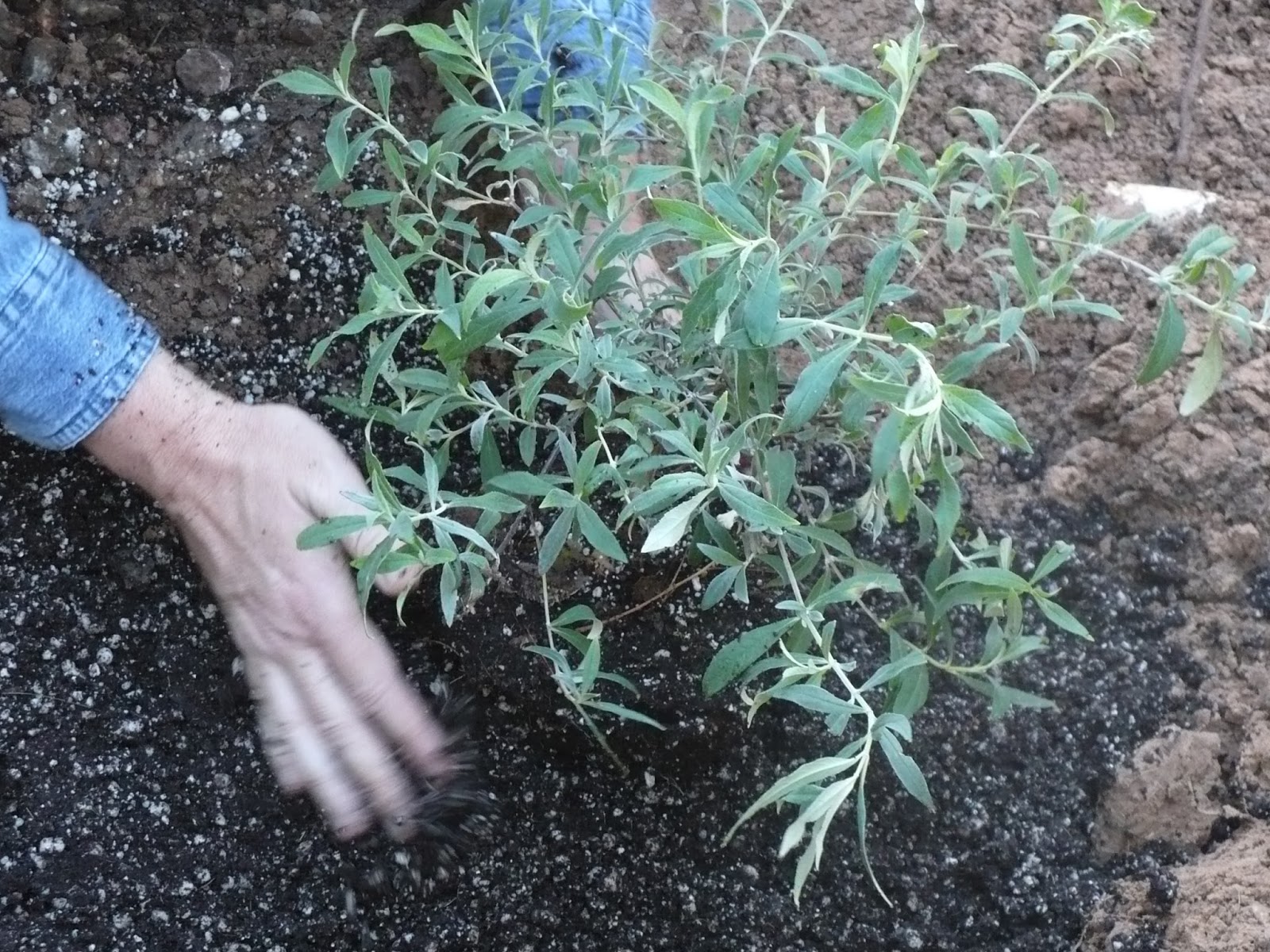
Remember the butterfly bush that we rescued from the clearance rack of 'the orange store' last year?  We carefully pruned the broken branches off it, transplanted it to this bigger pot and eventually planted it in the ground on the East side of the house.


It
recovered well and was doing great.....until the neighborhood cats decided it was a nice thing to lay on and play with that is.   So, then we put this little fence around it with a 'roof' of sticks on top to keep them out.


The cats had broken most of the new branches that had grown on it over the winter after we transplanted it and we weren't sure if it would recover from this. 

But now, it has grown a few new branches and one of them is even blooming!  This is one tough plant and is certainly a good choice for landscaping in our climate of the Mojave Desert.  It gets just a little water every day from the soaker hose that you may see in the pictures above. The hose circles around the plant just outside the dripline (or where the dripline was before the cats mangled the plant).  That seems to be all it needs once it is established and is still this size. As it gets bigger, we'll set up a bigger irrigation system for it using netafin tubing.

It is doing well now, but has really lost a lot of ground compared to where it would be by now had it not suffered cat-astrophic damage.  If you have cats, please keep them inside!  Do not let them run your neighborhood tearing up other people's stuff and turning their yards into outdoor litter boxes.  Much of the upkeep for the yard at this house is trying to clean up after all these loose cats.


First bloom on this butterfly bush since the cats mangled it earlier this spring.

Sunday, May 1, 2016

Celebrating April Showers

 Living in an arid place, like the Mojave Desert, really makes me appreciate and celebrate rain more than I ever have anywhere else.  In Eastern Oklahoma and Nebraska, most Springs (except for the droughts of course) were so rainy that it became a nuisance and I'd come to dread another rainstorm by the time Summer had finally arrived. But here, it rains so seldom that every rainstorm is exciting!

I'd like to take a break from my usual blog post style to just share some pictures I took with you right after a nice, long (for here anyway) rain shower.


I hope you enjoyed these pictures. It was fun taking them. Rain makes the air cleaner and washes off all the dust making everything seem fresh and new.