Showing posts with label buddelia. Show all posts

Friday, May 20, 2016

First Bloom on Butterfly Bush Recovering From Cat-astauphic Damage


Remember the butterfly bush that we rescued from the clearance rack of 'the orange store' last year?  We carefully pruned the broken branches off it, transplanted it to this bigger pot and eventually planted it in the ground on the East side of the house.


It
recovered well and was doing great.....until the neighborhood cats decided it was a nice thing to lay on and play with that is.   So, then we put this little fence around it with a 'roof' of sticks on top to keep them out.


The cats had broken most of the new branches that had grown on it over the winter after we transplanted it and we weren't sure if it would recover from this. 

But now, it has grown a few new branches and one of them is even blooming!  This is one tough plant and is certainly a good choice for landscaping in our climate of the Mojave Desert.  It gets just a little water every day from the soaker hose that you may see in the pictures above. The hose circles around the plant just outside the dripline (or where the dripline was before the cats mangled the plant).  That seems to be all it needs once it is established and is still this size. As it gets bigger, we'll set up a bigger irrigation system for it using netafin tubing.

It is doing well now, but has really lost a lot of ground compared to where it would be by now had it not suffered cat-astrophic damage.  If you have cats, please keep them inside!  Do not let them run your neighborhood tearing up other people's stuff and turning their yards into outdoor litter boxes.  Much of the upkeep for the yard at this house is trying to clean up after all these loose cats.


First bloom on this butterfly bush since the cats mangled it earlier this spring.

Friday, October 9, 2015

Rescued Butterfly Bush Finds A Home

Butterfly Bush Buddleia davidii

This Butterfly Bush (Buddleia davidii) was rescued from the discount rack at a local big box store that we call 'The Orange Store'.  It came in a tiny, flimsy plastic pot barely big enough for the roots, but only cost $2. It was wilty and sad looking at the time, but we saw promise in it because it had the best formed trunk and branches; no obvious evidence of girdling roots and several flower buds. 

When we brought it home, we put it in a spot under a California fan palm sapling (that will be transplanted too someday) and on the East side of the house to protect it from being blasted by the hot, setting sun each afternoon.  We transplanted it into two nested pots filled with a soil-less potting medium high in pearlite to ensure drainage and watered it until water began to drip from the bottom of the pot (it was sitting on a stand so that the water could drain out) every day.  

After it quit wilting, about two weeks later, it started to flower. The flowers sure are pretty! We are looking forward to seeing how it looks when the plant can support full inflorescences of blossoms.


Butterfly bush blossoms


The pink blossoms contrast nicely with the opposite leaves of this plant which are dark green on top (adaxial surface) and covered with fine, silvery white hair-like wax on the bottom (abaxial surface).  It may continue to produce pink blooms, or the next set might be a darker red, even almost purple as these plants have some variety in blossom color.  The flowers are quite small as seen above and are rather simple, yet elegant, in design with one row of petals, each with serrated edges, fused into a tube with a deep center that hides the pistil and stamens. 

Butterflies and hummingbirds possess tongues long enough to access the sweet nectar that these flowers produce.  We hope that this bush will become a natural feeder for them so that we'll get to enjoy watching them flit around the yard.  Since we never spray pesticides in our yard, we think we stand a better than average chance of attracting them now with this bush.


Once the bush flowered for a while (another couple of weeks) and even began growing new leaves (a very hopeful sign that it might survive after all), we decided to transplant it again.  The weather was cooperating too with highs in the 80's forecasted the whole week and a 40% chance of rain.  Cool, rainy weather is ideal for transplanting many species in the desert. 

To give the plant the best chance of success, we carefully planned its new location.  A well placed and well dug hole is the key to success when it comes to transplanting out here.

The ideal spot was between this wall
And this planter
We paced 7 ft from the wall to give the bush room to grow

This is a good spot because it will get morning sun, but afternoon shade from the house and it is close enough to my makeshift drip irrigation set up (someday, I'll install a proper irrigation system) that I can set a drip on it if I'm gone for an extended period.  It is also in a fairly level spot which will make controlling runoff much easier than planting on a slope.

Butterfly bush can grow to be about 15 feet wide and 12 feet tall, so we wanted a location where it would have plenty of room to grow without getting in the way of anything.  As you may have noticed from other blog posts, we are not big fans of needless pruning.  Had we planted this bush closer to the sidewalk or wall, it would need pruned almost annually.  Where it will be, it won't be too close to any of the traffic paths, and may even cast a little shade over the planter box someday. 


"Weed Barrier" is in the way!
Weed Barrier is a myth. It doesn't prevent weeds for more than a couple of years after installation.
Fine gravel under the plastic?
When we started digging, we discovered to our dismay, that the previous owners of this property had fallen for the myth that putting a layer of black plastic under your rocks would prevent weeds.  Apparently, they placed it over the entire yard.  We'd already removed some of it around the trees shortly after we moved in.  This plastic is going to have to go away if we can hope for healthy root systems for our plants.  It's preventing gas exchange between the soil and the air and is impeding water infiltration.


Good soil under the rocks
The soil profile of our yard. Note the compacted layer on the surface.


Now that we've gotten the rocks and plastic and compacted soil out of the way (please oh please dear reader, never cover your yard with rocks no matter what your water district says!), we've found actual soil.  We're blessed to have chosen a location in the Las Vegas Valley that has loamy sand soil with fine gravel! This is primo soil for the Mojave Desert. Very good drainage and just barely enough clay and loam in it to help hold moisture and nutrients.  Other places in the valley aren't so lucky and have layers of caliche 'clay' which is actually coral that was pulverized and buried when the volcanoes that are now the Black Mountains to the South erupted, burying what was once a huge lake as big or bigger than the Great Salt Lake to the North of us.  Where I am digging used to be part of the shoreline around that lake and is a bit more like digging in a beach than a lake bottom.  This is perfect for many desert native and adapted plants, including our little Butterfly bush.

I know this soil well, so I know what its physical and chemical properties are.  If I wasn't sure, I'd do a couple of tests before deciding to plop a plant in here.  First, I'd get a little vinegar and drip it in a shallow hole.  If it fizzed a lot, I'd know that the soil was very alkaline and may not be the best material to use for a plant species that is not adapted to the desert (such as roses or violets). Then, I'd dig a small hole down to my planned root zone depth and fill it with water, noting the time that I did so.  I'd come back every 10 minutes or so to check the water depth.  If the hole still had standing water in it after 30 minutes, I'd consider planting somewhere else or build a raised bed if there were no other good locations for the plant.  Never plant anything (other than maybe plants from swamps or marshes) in a place with poor drainage. Your plants will never be healthy there. 


We
dug the hole down just as deep as the flower pot was and about four times as wide to be sure to get as much plastic and rock out of the way as possible.

Luckily, the pot happens to be as deep as a spade is tall....


Makes measuring hole depth easy

People used to think that digging a really deep hole was key, but research has found that most trees and shrubs do not grow a really long tap root that winds up being as deep as the tree is tall. Only a very short list of trees actually do that, most of which aren't even grown in the U.S.  Actually, the key to tree stability is lateral roots. A wide fan of lateral roots extending out beyond the drip line of the mature tree canopy is what keeps trees from falling over.  That's why one spade deep is deep enough for this bush, but we made it as wide as we could. Someday, we'll probably come back and dig up even more of the rocks and plastic and move them out of the way as the bush gets bigger. 
Gently tapping the rootball out of the pot...

keeps the roots from being damaged
 
Placing the rootball in the hole, ensuring that potting soil is under and on all sides of it


Since the Butterfly bush was grown in soil-less potting media, we chose to keep that around the roots and to line the inside of the hole with it.  Our soil is pretty good by desert standards, but it's good to keep as much of the original soil around the roots to avoid breaking off any more root hairs (the tiny, almost invisible parts of roots that do all of the water and nutrient uptake) than we have to.  Eventually, the roots will grow out of the potting media and into the native soil, so we made sure to avoid compacting the bottom and sides of the hole, even raking at the surfaces with our fingers to make sure the spade didn't compact the soil too much.  Smooth, firm holes just become underground pots, preventing future root growth.
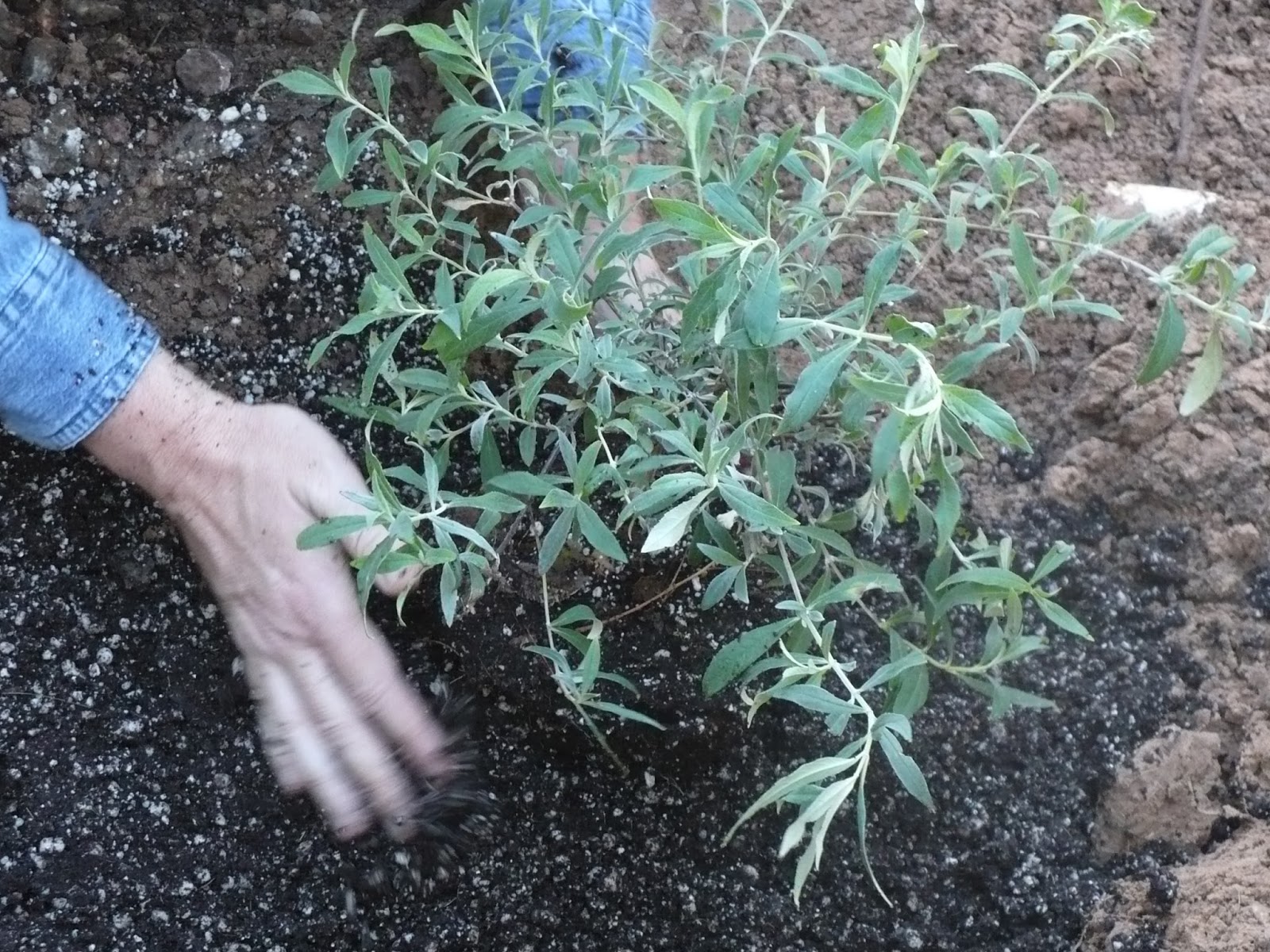
The native soil was gently placed around and on top of the rootball and gradually sloping away from the trunk, leaving a gap about a finger's width around the trunk to help prevent stem rot.


Bare soil was then covered with wood chip mulch out to what will soon be the dripline
Now that the plant was in the hole, we gently placed native soil around the sides of the potting media pile and over the top of it up to about a finger's width of the trunk.  Then, we covered that with a two to three inch thick layer of wood chip mulch also within a finger's width of the trunk.  That will help reduce the chance of stem rot that sometimes happens when soil and mulch are piled up around the trunk.  The mulch will help keep the soil moist and reduce soil erosion.  We used such a thick layer to help prevent weeds and to keep the mulch in place better than a light scattering would have.  As the bush gets bigger, we will move more rock and plastic away from it and add more mulch in its place. 

We then irrigated the plant with about a gallon of water and will water it about every other day to prevent wilting.  Thanks to the good drainage of this soil, that won't water-log the roots.  In heavier clay soil or in caliche, we would have to wait longer between waterings to avoid drowning the roots.  If the soil was really tight, we would have just built a tall planting box full of potting medium on top of the ground with a reservoir hole filled with gravel underneath it and planted the bush in that.  Once the bush is established, a deep watering once a week will be all it needs, even in summer.   

  Now, if all goes well, no guarantees when it comes to growing things, we'll have a lovely Butterfly bush to enjoy for years to come. 


Monday, August 31, 2015

Rescued Butterfly Bush


Freshly transplanted Butterfly Bush

One of the things we love to do when we visit the 'big box' home improvement stores towards the end of a season is to look for the bargains.  It's the best time to buy 'seasonal' stuff that you know you'll use next year anyway.  Most of my gardening tools that we've bought new (most of our tools are actually either my grandma's or are from thrift stores) were from sales like that.  It's part of making gardening financially sustainable. 

Even better is when we find plants languishing on the 'clearance' racks.  The poor things! We are sorely tempted to buy the whole rack of them, but usually manage to restrain ourselves to getting the ones that look like they are more likely to survive after a little TLC.  In this case, we found a shrub with very few broken branches, a well developed main stem, no signs of disease (such as weeping bark, weird growths or galls etc) and dry, but relatively well developed leaves.  This one also had only a couple of previous flowers on it which is good in this case as a profusion of flowers tends to indicate that the plant is really stressed and attempting to ensure the survival of its kind by throwing all of its remaining resources into seed production. This process of looking the plant over critically is kind of like triage for plants. 

This season, one of the plants we've rescued is this Butterfly bush
Buddleia davidii.  It's a perennial that will die back to the root crown after a hard freeze and then grow back up the next spring to be about two or three feet tall, assuming of course that they have adequate root reserves.  If the plant is under-watered and stressed the growing season before it freezes, it will just die.  If we don't have any hard freezes during the winter (which sometimes happens here) it will continue to grow and get to be a bigger plant.  Though they start out small when we buy them, these are true shrubs and can get to be around 15 feet tall and about 10 feet wide if people don't prune them to death and if they are planted in a good spot with protection from North winds yet still enough room between the trunk and the nearest hard, immobile structure or walkway to grow.  With perennial plants, a good deal of thought put into where and how it is planted will give you a healthy plant. Lack of planning gives you either a dead plant in the near future or a headache of a plant that is always 'in the way'.  

This little gal that we've rescued has the start of a true trunk with a layer of grey, corkey, shredded bark, so she's probably two to three years old as it takes a while for the bark to develop.  She'll probably start sprouting new stems from the base at some point, which we'll let her do.  We hate to prune plants up to fit some preconceived idea of what they should be rather than what they naturally are.

This plant is developing a true trunk but may sprout from the base later

Butterfly bush has striking, dark green leaves with silvery bottoms, thanks to a thick coating of short wax 'hairs' on the abaxial side of the leaf blades. The leaves are small, thin, lanceolate and entire with slightly serrate margins.  They are one of those plants that are lovely to have around as they don't drop their leaves very often and when they do, the leaves are so small that they don't tempt people to rake them up.  It's namesake comes from the beautiful purple (sometimes white) clusters of tiny flowers.  The flowers are tubular with four tiny petals at the fringes of the tube.  Hummingbirds, butterflies and other flying, nectar sucking critters love these flowers, so hopefully, this plant will act as a natural humming bird and butterfly feeder and we'll start seeing more of those lovelies in our yard again.  At our previous residence, we had Salvia bush growing nearby which is also a great plant for these creatures to feed on. 
Remnants of a previous flower stalk

Hopefully, ours will have flowers like this on it someday


We found this plant in a tiny little pot that was barely big enough for it, as evidenced by all the roots that were starting to emerge from the soil in the top of the pot and to circle the bottom of the inside of the pot.  When we transplanted her, we gently broke those circling roots up and pruned the tips of them off to encourage them to start growing outwards into the soil-less media that we put in the current pot.  We chose soil-less media because that was what was in the pot that we bought.  It's best to try to minimize barriers created by sudden changes in soil texture and structure when transplanting as water doesn't travel very well from one type of soil into another type that is quite different from it.  When that happens, you wind up with lots of water in the pot, but a dry rootball.  The pot that we transplanted it into is large enough that it can stay in there until the bush is recovered from the shock of the poor treatment it was getting at the store and from being transplanted. She'll also benefit from being in the shade of a little palm tree Washingtonia filifera on the East side of the house until she's a bit bigger and stronger.

Later on, when the shrub begins to grow larger and the branches start hanging over the edge of the pot, we'll consider locations to plant it.  There's a good spot for it along the North end of the West facing wall where it will get partial shade from the house and nearby oleanders in the afternoon and it will get protection from the North wind in winter.  We'll never put planting stakes on her as we've learned that trees and shrubs actually grow stronger and more stable without them, especially if you don't prune all the lower branches off in a misguided attempt to 'train' it into being a miniature, mature looking tree.  We may build a raised bed for it at that time so that we can give it amended soil and plenty of rooting space more easily.  That will be an interesting adventure that we're looking forward to sharing with you on here.